The Georgia Dogman
Overview
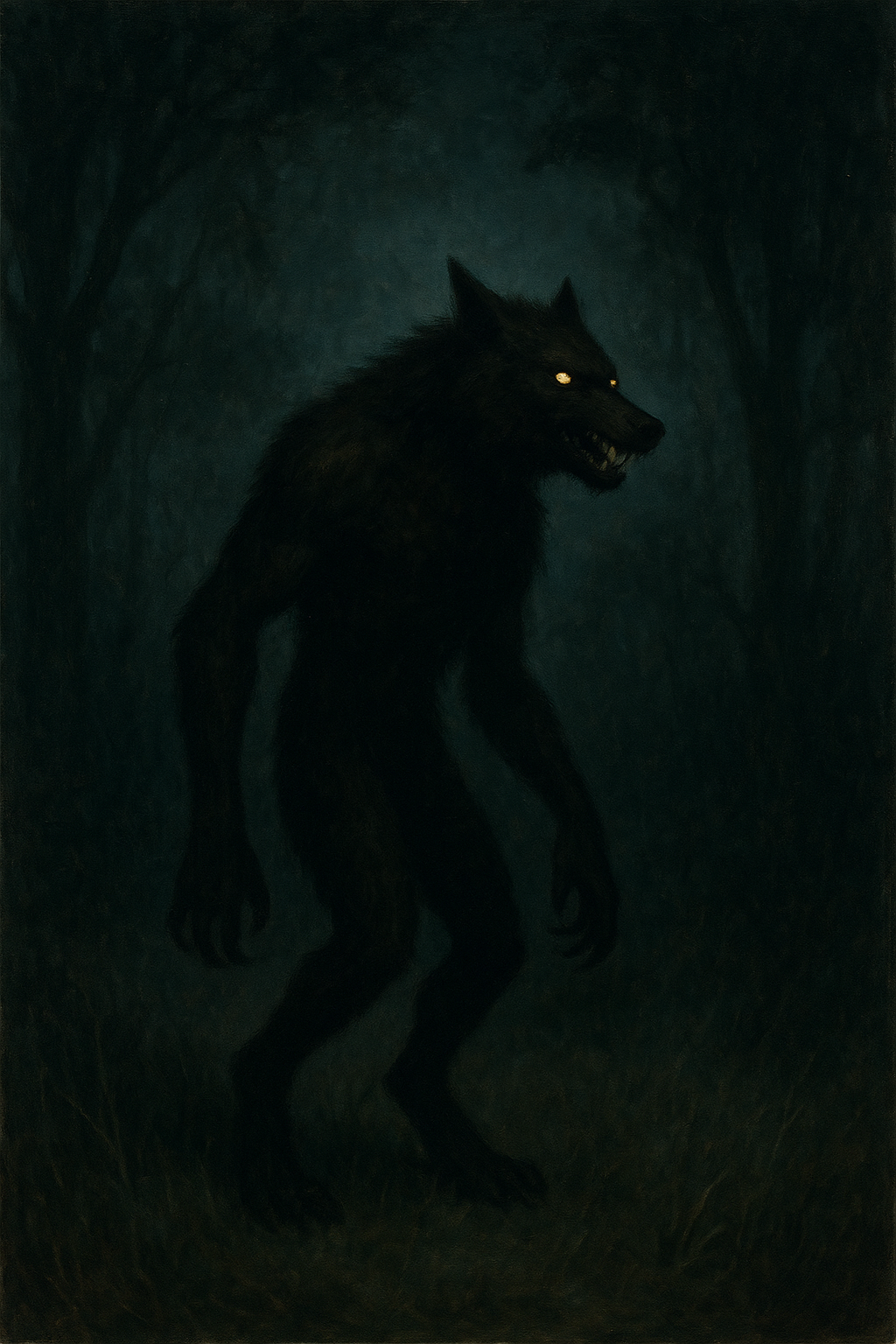
Description
The Georgia Dogman is described as a towering, bipedal creature, often standing seven or eight feet tall. Its body is covered in thick, dark fur that glistens like oil under the moonlight. Witnesses say it moves with unnerving grace — able to walk upright like a man or drop to all fours in an instant. Its head resembles that of a wolf or massive dog, complete with pointed ears, a long snout, and gleaming teeth. The most chilling feature, though, is its eyes — glowing, yellow, and intelligent. Those who’ve seen them up close describe the sensation of being watched, studied, even judged. And then there’s the smell. Accounts describe an overwhelming odor of wet dog, decay, and something old — something primal.
A Cryptozoological Analysis of the Georgia Dogman
Introduction
The “Georgia Dogman” is a regional variant of the broader “upright canid” cryptid reported across North America. While lacking physical evidence such as DNA, verified footprints, or carcasses, the Georgia subset offers a distinctive pattern of sightings that makes it a compelling subject for cryptozoological study.
This analysis evaluates:
- Environmental factors
- Biological plausibility
- Patterns in eyewitness reports
- Known animal analogs
- Cultural and folkloric influences
1. Regional Habitat Suitability
Georgia’s ecosystems — especially in the north Georgia mountains, Piedmont forests, and coastal wetlands — provide excellent conditions for rare or elusive animal species.
1.1. Key Environmental Features
Dense woodland cover:
Hardwood and pine forests provide visual concealment and stable territory.
High prey density:
Deer, feral hogs, small mammals, and abundant water sources could sustain a large predator.
Low human presence in rural areas:
Sightings often occur on remote roads, hunting land, or farmland edges — typical habitat for reclusive wildlife.
1.2. Comparison to Known Large Mammals
Georgia is home to:
- Black bears
- Coyotes
- Feral dogs and hybrids
All can exhibit unusual behaviors when stressed, injured, or diseased — factors that influence misidentifications.
2. Eyewitness Consistency and Behavioral Patterns
Dozens of accounts share three consistent traits:
2.1. Phenotypic Description
Commonly reported features include:
- Height: 6–8 feet upright
- Digitigrade legs (dog-like stance)
- Canine head with pointed ears and elongated snout
- Broad chest, muscular shoulders
- Dark, shaggy fur
These align with other North American Dogman reports, suggesting a shared archetype rather than random hallucinations.
2.2. Behavioral Traits
Witnesses describe:
- Territorial pacing
- Avoidance of direct contact
- Short-distance pursuit of vehicles
- Curiosity toward human dwellings or livestock
The combination of predatory confidence (approaching property lines) and avoidance (retreat when observed) is typical of large canids.
2.3. No Reported Opportunistic Attacks
Despite intimidating behavior, there are no confirmed aggressive attacks.
This is notable — apex predators (wolves, coyotes, big cats) often avoid unnecessary confrontation.
3. Potential Zoological Explanations
3.1. Misidentified Black Bears
Black bears:
- Can stand upright up to 6–7 feet
- Have tapered snouts (though shorter than canids)
- Exhibit curious, territorial behavior
However, several eyewitnesses specifically note:
- A decisively canine head
- Digitigrade movement while upright
- Long arms with clawed hands rather than paws
The head shape and locomotion remain the biggest points of contention.
3.2. Wolf–Dog Hybrids
Georgia has:
- Increasing coyote–dog hybrids (“coywolves”)
- Occasional wolf-dog pets or escaped hybrids
- Large feral dog populations
Hybrids can:
- Reach larger sizes
- Exhibit unusual morphology
- Behave boldly in rural areas
But even the largest wolf-dog hybrids don’t naturally walk upright for extended periods.
3.3. Unknown Reclusive Species or Mutated Lineage
Cryptozoologists sometimes posit:
- A surviving relic canid species
- An unusually large, capable bipedal canid mutation
- A primate species with convergent traits resembling canids
However, the lack of physical remains or fossil record supporting a bipedal canid lineage in North America makes this hypothesis less likely in standard zoology.
4. Anthropological and Folkloric Context
Georgia has a rich mix of folklore that may influence perception:
4.1. Indigenous Cherokee Lore
Stories include:
- Wolf-like guardians
- Animal-people hybrids
- Forest shapeshifters
These traditions may frame how modern witnesses interpret unusual animal encounters.
4.2. Appalachian Werewolf Traditions
European settlers brought lycanthrope myths, which merged into Appalachian storytelling.
The Dogman could represent a continuation or reinterpretation of these older beliefs.
4.3. The “Upright Canid” Internet Phenomenon
Since the early 2000s, Dogman reports have surged globally.
Online narratives may influence memory or interpretation in ambiguous encounters.
5. Cognitive and Perceptual Factors
Human perception at night is notoriously unreliable:
5.1. Nighttime visual distortion
Low light exaggerates size, motion, and shape. Shadows obscure expected anatomical cues, increasing misidentification risk.
5.2. Fear-based memory alteration
Fear accelerates memory distortion, especially when:
- Witnesses are alone
- In unfamiliar environments
- Under stress or sensory deprivation
This doesn’t disprove sightings, but it complicates interpretation.
6. Summary of Scientific Plausibility
6.1. Likely Explanations
- Black bears exhibiting upright posture
- Large dog, feral canine, or hybrid misidentifications
- Combination of fear, darkness, and misperception
- Folkloric influence shaping interpretation
6.2. Less Likely (but not impossible)
- Unknown canid species
- Hybridized or mutated population of bipedal canids
- Relict population from prehistoric lineages
In terms of zoological probability, the Dogman falls into the category of “plausible but unverified” — similar to Sasquatch.
6.3. What Would Constitute Evidence?
To establish legitimacy, researchers would need:
- DNA samples
- Clear tracks inconsistent with known species
- High-resolution, verifiable footage
- Multiple independent eyewitnesses in a single event
- Physical remains
None currently exists.
Final Assessment
The Georgia Dogman remains a compelling cryptozoological figure, supported by:
- Clusters of consistent eyewitness reports
- Suitable habitat
- Cross-cultural parallels in regional folklore
But the absence of biological evidence means the creature sits squarely between myth and misidentification, with a faint possibility of an undocumented species.
Still, until science can conclusively stamp it out, the Georgia Dogman persists — both in the shadows of the pines and in the imagination of those who swear they’ve seen something evolution can’t quite explain.
Behavior
Reports of the Dogman stretch across Georgia, from the misty North Georgia mountains to the dense southeastern swamps. Hunters, campers, and travelers have told stories of hearing deep growls echoing through the trees or catching sight of an upright figure just beyond the tree line. Some say it follows people who wander too deep into the forest. Others claim it appears near lonely backroads at night, illuminated for a moment by headlights before vanishing into the dark.
Reported Sightings (1)
View Sightings MapYellow eyes and top of head
Geographic Distribution
Georgia
USA
North Georgia mountains to the dense southeastern swamps
Characteristics
8 feet