Fouke Monster
Overview
Description
The Fouke Monster: Arkansas’ Swamp Legend That Still Haunts Boggy Creek
Introduction
Deep in the shadowy bottomlands of southern Arkansas, whispers of a towering, hairy creature have echoed for over a century. Known as the Fouke Monster, or the Boggy Creek Monster, this cryptid has become one of America’s most enduring legends. From terrifying encounters in the 1970s to modern-day sightings, the Fouke Monster continues to captivate cryptid enthusiasts, skeptics, and pop culture alike.
SEO Keywords: Fouke Monster, Boggy Creek Monster, Arkansas cryptid, Fouke Monster sightings, Boggy Creek legend
Origins of the Legend
The Fouke Monster’s story begins long before the headlines of the 1970s. Reports of a “wild man” in Arkansas date back to the mid-19th century. By the mid-20th century, sightings near Jonesville earned it the nickname “Jonesville Monster.”
But the legend truly exploded in May 1971, when Bobby and Elizabeth Ford claimed the creature attacked their rural home near Fouke. Bobby described a seven-foot-tall, red-eyed beast that tried to drag him away. Investigators found three-toed tracks and claw marks on the porch, sparking a media frenzy that put Fouke on the map.
Physical Description & Behavior
Eyewitness accounts paint a chilling picture:
- Height: 7–10 feet tall
- Weight: 250–800 pounds
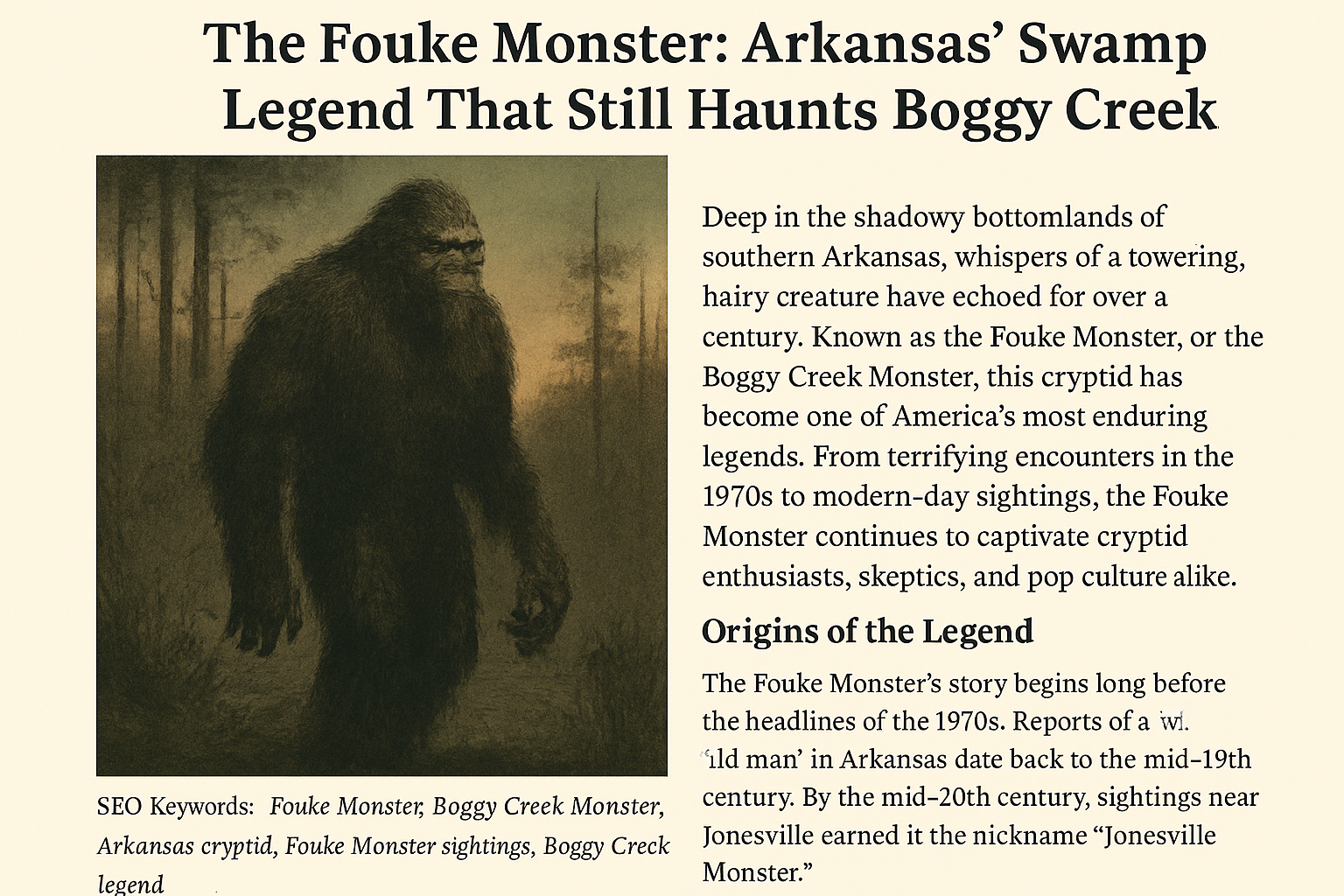
- Appearance: Covered in dark, shaggy hair; ape-like face
- Eyes: Glowing red, “silver dollar” size
- Odor: A stench like a mix of skunk and wet dog
- Tracks: Up to 17 inches long, often with three toes
- Behavior: Aggressive, territorial, capable of running with a galloping gait; emits loud howls and growls
Unlike the shy Bigfoot of the Pacific Northwest, the Fouke Monster has a reputation for hostility—scratching at homes, chasing cars, and terrifying hunters.
Habitat: The Sulphur River Bottoms
The Fouke Monster’s lair is believed to be the Boggy Creek area, part of the Sulphur River Bottoms in Miller County. This region is a dense, swampy wilderness of bottomland hardwood forests, creeks, and marshes—perfect for hiding from human eyes. Sightings often occur at twilight, when the creature reportedly emerges to hunt or roam.
Cultural Impact: From Folklore to Film
The Fouke Monster’s fame skyrocketed with the release of The Legend of Boggy Creek in 1972. Directed by Charles B. Pierce, this low-budget docudrama grossed over $22 million, becoming a cult classic and cementing the creature’s place in pop culture. Sequels, documentaries, and books followed, including Lyle Blackburn’s The Beast of Boggy Creek, which chronicles sightings and the making of the film.
The monster has appeared in TV shows like MonsterQuest, Finding Bigfoot, and The UnXplained, and Fouke hosts an annual Boggy Creek Festival, celebrating its eerie claim to fame.
Modern Sightings & Ongoing Mystery
Reports didn’t stop in the 1970s. Sightings surged in the late 1990s, and as recently as the 2020s, locals claim to have encountered the beast near Boggy Creek. Evidence includes plaster casts of three-toed footprints and claw marks, though skeptics argue these could be hoaxes or misidentified animals like black bears. Still, the mystery persists, drawing cryptid hunters and tourists to Fouke every year.
Theories: What Is the Fouke Monster?
- Undiscovered Species: A relic hominid or unknown primate
- Misidentification: Black bear or other wildlife
- Hoax: Tracks and sightings staged for attention
- Supernatural Entity: Some locals whisper of paranormal origins
Despite decades of investigation, no definitive proof exists—making the Fouke Monster one of America’s most tantalizing cryptid mysteries.
Visiting Fouke Today
For those brave enough, Fouke offers Boggy Creek tours, souvenir shops, and photo ops near the famous creek. Just remember: as the sun sets over the Sulphur River Bottoms, keep an eye on the woods—you never know what might be watching.
Behavior
Nocturnal, aggressive, attacks property, strong odor
Reported Sightings (0)
No reported sightings yet.
Geographic Distribution
Arkansas, USA
Fouke swamps and bottomland
Characteristics
7 feet, 250-300 lbs
Historical Context
1940s, major wave 1971-1974
Modern sightings, documentary film