Dark Watchers
Overview
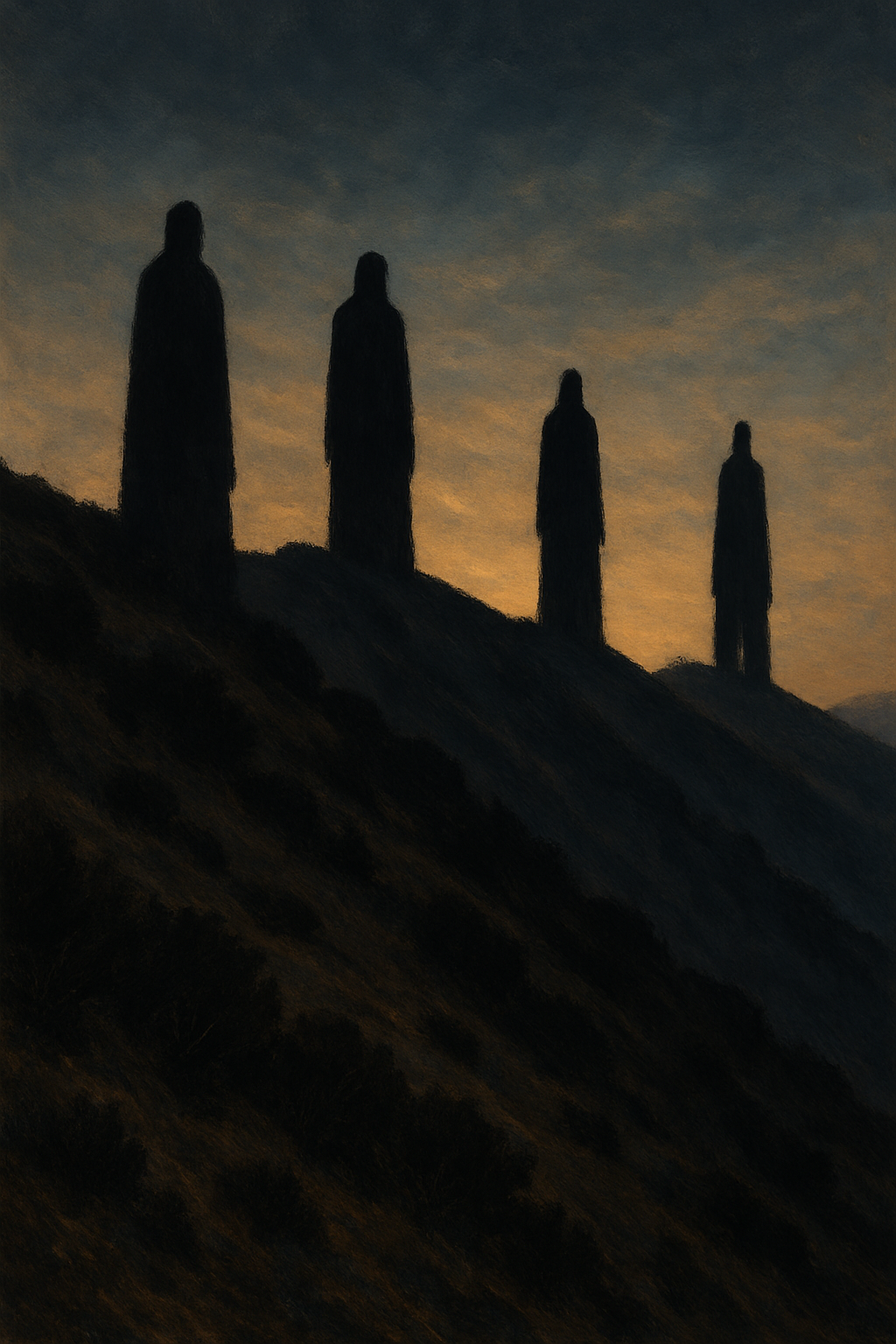
Description
The Watchers of the Santa Lucia: Shadowy Figures on the Ridgelines
There are places in California where the land feels older than the stories told about it—older, even, than the people who first named its peaks and waterways. The Santa Lucia Mountains are one of those places. Stretching along the coast, lifting abruptly from fog-soaked redwood canyons into sharp, sun-burned ridges, the range has always had a reputation for holding secrets. One of the strangest and most enduring involves the tall, dark silhouettes said to appear on the ridgelines at twilight—silent, unmoving figures that watch but never approach.
Travelers have described them for well over a century: elongated human-like shapes, far too tall to be hikers, standing alone against the fading sky. They appear just as the sun dips low or when the fog begins to rise again from the sea. Some claim these figures vanish the moment you shift your eyes; others insist they remain perfectly still until a cloud slides past and then—without any obvious moment of movement—are simply gone.
An Old Presence in a Young Land
Long before ranchers and explorers made their way through the area, the Chumash people lived along the central Californian coast and carried with them a deep spiritual relationship with the mountains. Though not all stories are meant to be shared outside the community, various retellings hint at beings who inhabited the high places—watchful spirits, guardians, or sometimes tricksters depending on the version. These mountain figures were not meant to be feared exactly, but respected, acknowledged, and never provoked.
Descriptions of the modern “shadow watchers” echo some of these older traditions. They are often seen where cliffs break sharply, where the terrain becomes dangerous, or where a trail veers too close to the edge. Some hikers feel the figures serve as warnings: turn back, the land seems to say, or tread more carefully.
Steinbeck’s Glimpse of the Unexplained
John Steinbeck, who grew up in Salinas with the Santa Lucias dominating his western horizon, sprinkled hints of the phenomenon into his fiction. In the short story “Flight,” he mentions dark, upright silhouettes appearing along the mountain crests, figures that seem both human and not. Steinbeck offers no explanation—he simply lets them stand there, inscrutable as the landscape itself. His casual inclusion suggests that such tales were common enough in his childhood to be treated as ordinary folklore rather than fringe superstition.
Steinbeck never claimed these watchers were real. Yet his willingness to place them on the page makes the mountains feel alive with possibility, their ridgelines stages for half-seen presences that defy tidy categorization.
Natural Illusion or Something More?
Skeptics attribute the silhouettes to a variety of perfectly earthly phenomena:
- Brocken specters, where a person’s own shadow is cast against fog in a way that makes it appear enormous and distant
- Optical distortions created by late-day light and marine layers rolling inland
- Wind-sculpted trees, burned snags, or oddly placed boulders that take on human shapes from the right angle
And yet, many who claim to have seen the watchers insist that these explanations don’t quite account for what they observed. The shapes are too defined, too deliberately placed, too eerily still. Whether or not that’s true is impossible to say. But the persistence of the stories suggests that, at the very least, something about the Santa Lucias triggers a deep instinct in the human mind—a readiness to populate lonely horizons with something that can look back.
The Psychology of the Ridgeline
There’s something uniquely haunting about a solitary figure outlined against a dying sky. It taps into a primal awareness: the sense of being observed, the unease that comes from knowing you are not the only presence in a vast wild place. Twilight enhances that tension—colors drain, depth perception wavers, familiar shapes turn ambiguous.
The Santa Lucia Mountains also possess a geological and atmospheric drama few places can match. The marine fog surges inland like a living thing, then thins without warning, leaving sudden pockets of clarity. A hiker can move from blinding white to shimmering sunset in minutes. In such shifting conditions, the mind has to interpret shapes quickly, sometimes incorrectly, sometimes with imagination filling in the rest.
Why the Stories Endure
Even if the watchers are illusions, they represent something more enduring: the sense that wilderness is still capable of mystery. In a world of satellite imaging, GPS-mapped trails, and high-resolution cameras, the idea that a person could turn a corner on a late-evening trail and freeze at the sight of an unnaturally tall silhouette is both unsettling and irresistible.
Every culture builds stories around the landscapes that shape it. The Santa Lucias, with their knife-edged ridges and steep drop-offs into the Pacific, invite tales of watchers—beings who belong to the mountains more than the people who wander through them.
A Quiet Reminder
Whether they are spirits, shadows, or tricks of light, the figures on the ridgelines serve a purpose. They remind us that the world is not fully tamed. They urge caution. They provoke curiosity. They give the mountains a mythic dimension that fits perfectly with their austere beauty.
Next time you’re hiking at dusk in the Santa Lucia range, pause for a moment and scan the crest above you. You might see nothing but jagged rock and wind-bent brush. Or you might catch the outline of something upright and still—something that seems to be watching. Whether it is real or imagined hardly matters.
Sometimes, the mystery is the point.
Behavior
Stand motionless on ridges, disappear when approached
Reported Sightings (0)
No reported sightings yet.
Geographic Distribution
California, USA
Santa Lucia Mountains, ridgelines
Characteristics
7-10 feet tall (silhouettes)
Historical Context
Ancient Chumash tradition, modern reports ongoing
Chumash indigenous tradition, California coastal folklore