Bridgewater Triangle Sea Serpent
Overview
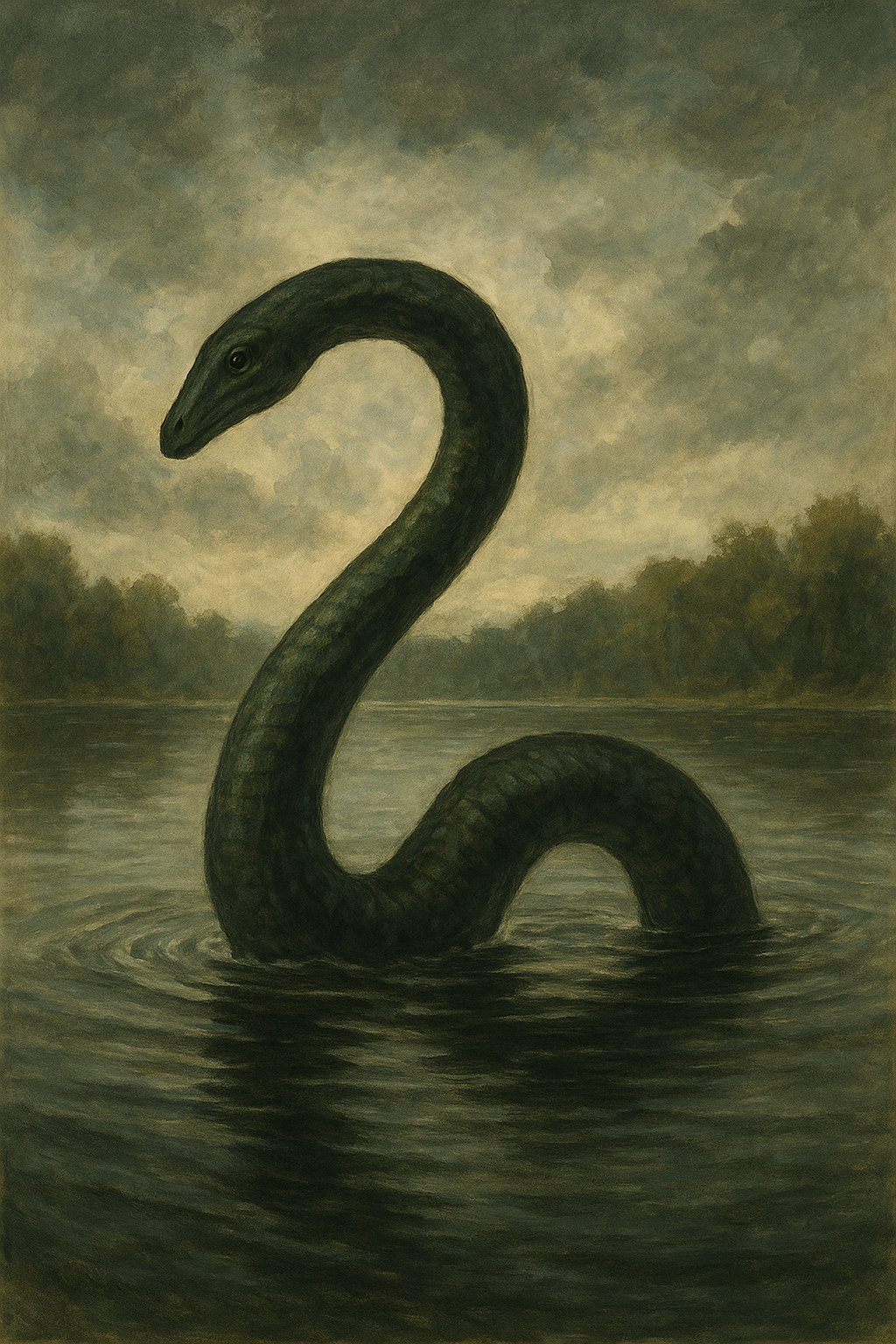
Description
The Bridgewater Triangle Sea Serpent: New England’s Most Elusive Cryptid
If you spend enough time wandering through southeastern Massachusetts—tracing the pine-lined backroads, drifting across its dark ponds, or listening to stories from locals who’ve called the place home for generations—you eventually hear whispers of a creature unlike anything else in New England folktale. It is not Bigfoot, though the Bridgewater Triangle has one of those too. It isn’t a ghost, though hauntings are practically a local pastime. Instead, it’s something far stranger: the Bridgewater Triangle Sea Serpent, a slithering, scale-covered mystery said to dwell in the region’s tangled waterways.
While most people associate sea serpents with the open ocean, Massachusetts’ most infamous “monster of the deep” appears to prefer far more confined quarters—rivers, lakes, and even narrow streams threading through the Bridgewater State Forest. The stories are old, the sightings numerous, and the behavior… well… unsettling.
This is the tale of the Bridgewater Triangle Sea Serpent: part legend, part cryptozoological puzzle, and part window into why this patch of land has captivated the curious for centuries.
What Is the Bridgewater Triangle?
First recognized by folklorist Loren Coleman in the 1970s, the Bridgewater Triangle is a roughly 200-square-mile area in southeastern Massachusetts. Its points typically include:
- Abington
- Freetown
- Rehoboth
Inside this triangular zone lies a cluster of the strangest phenomena in New England: UFO sightings, thunderbirds, haunted swamps, cult activity, poltergeist encounters, and of course—monsters.
At the center of the Triangle is the infamous Hockomock Swamp, whose name in Wampanoag roughly means “place where spirits dwell.” With more than 16,000 acres of wetland and wildlife habitat, it’s not hard to imagine something large, ancient, and unknown navigating its waters.
Early Sightings: A Beast in the Taunton River
The earliest known account of a large serpentine creature in the area dates to the 17th century. European colonists travelling along the Taunton River described encounters with a “snake as thick as a man’s thigh and longer than any tree trunk.” While the language was vague—colonists weren’t exactly zoologists—it marked the beginning of a centuries-long tradition.
Native Wampanoag stories tell of massive water spirits capable of churning up the river and swallowing canoes whole. These beings weren’t necessarily monsters but guardians, powerful forces woven into the landscape. Whether these stories refer to the same creature colonists spotted is unknown, but the overlap is intriguing.
The 19th-Century Surge in Reports
By the 1800s, local newspapers began running reports of a “great snake” cutting through the waters of the Taunton Riverand neighboring inlets. Rowers described a wake forming behind an unseen creature. Fishermen claimed it swam beneath their boats, revealing a ridge of bony humps.
One of the most often-cited encounters came from a group of men near West Bridgewater, who watched what they believed was a floating log begin to move against the current. The creature then lifted its head—black and reptilian—before slipping beneath the surface.
Descriptions from this era tend to agree on several features:
- A length anywhere from 30 to 60 feet
- A long, narrow head
- Smooth, dark skin
- A motion described as “like a snake, but faster”
This was no giant eel, no stray sturgeon, and no wayward whale. Whatever it was, it seemed perfectly at home in freshwater.
Twentieth-Century Resurgence: Encounters in the Hockomock Swamp
The modern “Bridgewater Triangle” era saw a resurgence of sea-serpent reports.
1950s–1970s: A Creature in the Marshes
Hikers and hunters reported spotting a huge black form sliding through the murky streams of the Hockomock Swamp. Some heard splashing that sounded “like an elephant entering the water.” Others described seeing a ridge—like a dragon’s spine—gliding across the surface.
During this period, sightings of other creatures (especially Bigfoot-like humanoids) spiked as well. Many cryptozoologists believe the Triangle’s high strangeness may represent overlapping phenomena—but the sea serpent remains one of the most consistent threads.
What Could the Sea Serpent Be? (Theories)
Cryptid scholars, biologists, and locals have offered many explanations. None fit perfectly.
1. A Giant Eel
American eels can reach about 4 feet—far from the enormous animals described—but some speculate that mutation or misidentification may exaggerate reports. However, eels move differently and don’t break the surface in the same way.
2. A Surviving Marine Reptile
A plesiosaur-like creature would explain the elongated neck and size, but the survival of such a species in shallow freshwater rivers strains belief.
3. An Unknown Freshwater Serpent Species
Large, undiagnosed serpentine species exist in folklore worldwide. With thousands of years of wetland ecology and very little deep exploration of the Hockomock, an undiscovered species isn’t impossible.
4. Cultural Memory of Wampanoag Water Spirits
Some researchers believe sightings may blend real animals with stories passed through generations—legends taking on new life with each retelling.
5. Hoaxes and Misidentifications
Inevitable, but insufficient to explain centuries of consistent description.
Why the Sea Serpent Endures
The Bridgewater Triangle draws people because it resists explanation. The swamp shifts with mist and shadow. The rivers are deep and slow. Wildlife rarely behaves exactly as expected. In a place where you can easily lose your bearings, seeing something extraordinary doesn’t seem strange at all.
The sea serpent persists because:
- Locals keep reporting it
- The landscape hasn’t changed much in 400 years
- Something does move through the waterways—large, fast, and rarely seen
And perhaps most importantly:
The Bridgewater Triangle invites belief. Its mysteries thrive where the rational world thins out.
The Modern Mystery: Still Sighted Today
Even in the 21st century, occasional reports surface:
- Fishermen seeing a long shape trailing under the water
- Kayakers describing something massive breaking the surface
- Nighttime observers hearing enormous splashes with no visible cause
These stories don’t make major news, but they continue—quiet, persistent, impossible to ignore.
For cryptozoologists, the Bridgewater Triangle Sea Serpent remains one of the most compelling freshwater monster legends in North America. Not as famous as Champ or Ogopogo, but older, more mysterious, and tied to one of the most paranormally active regions on the continent.
Final Thoughts: A Creature We’re Not Ready to Explain
Whether the Bridgewater Triangle Sea Serpent is a living relic, a misunderstood animal, a spirit from Wampanoag tradition, or something entirely new, its legacy endures. The waterways of southeastern Massachusetts are old, deep, and full of stories. And until the day someone captures definitive proof, the creature will continue to glide—unseen but always suspected—beneath their dark surfaces.
If you find yourself kayaking through the Taunton River or wandering the edges of the Hockomock Swamp, keep an eye on the water.
You never know what might be watching from below.
Behavior
Aquatic, surfaces occasionally, shy of humans
Reported Sightings (0)
No reported sightings yet.
Geographic Distribution
Massachusetts, USA
Hockomock Swamp, waterways in Bridgewater Triangle
Characteristics
15-20 feet long
Historical Context
Various dates, concentrated in 1970s-present
Bridgewater Triangle high strangeness area