Alkali Lake Monster
Overview
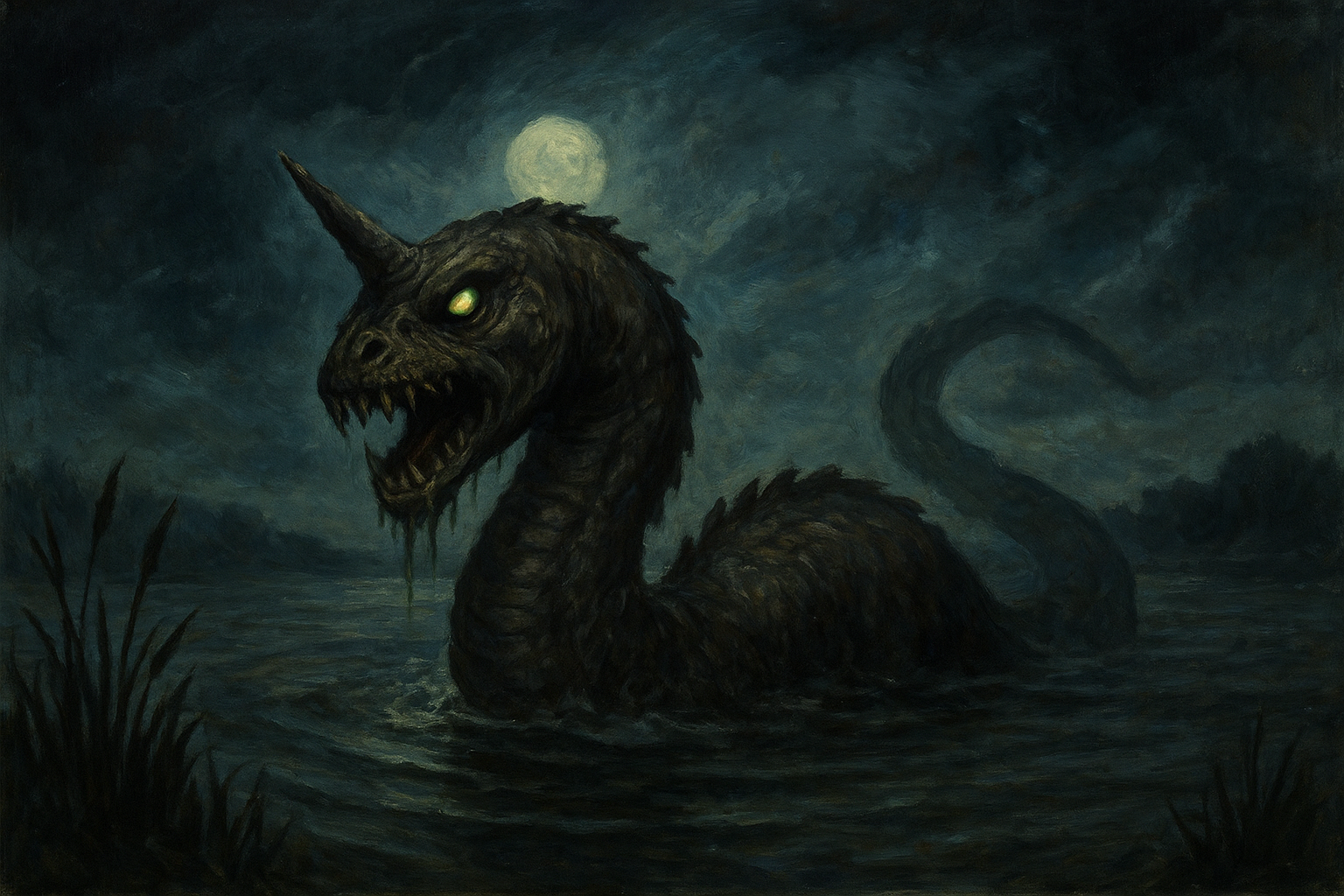
Description
The Legend of the Alkali Lake Monster
Hidden in the rolling plains of northwestern Nebraska, just outside the small town of Hay Springs, lies a modest 50-acre lake. Though now known as Walgren Lake, in old local lore it was once called Alkali Lake — and for nearly a century, this body of water has been whispered about as home to a terrifying cryptid: the Alkali Lake Monster.
Origins & First Sightings
The modern legend began in the early 1920s. According to local reports, J.A. Johnson and two companions camped on the shore of the lake one night in 1923. As darkness fell, they claimed to see something enormous moving in the water — just twenty yards away. What they saw was nothing like a common fish or bird: they described a monstrous creature roughly 40 feet long, dull gray-brown in color, and with a strange horn-like protrusion between its eyes and nostrils.
As the men watched, say the stories, the beast let out a “dreadful roar,” thrashed its tail violently, then dove back into the lake, leaving the men stunned and fearful. Some versions add that the creature’s splash created such a wall of water that they felt a tremor — as though the earth itself were shaking.
Physical Description & Behavior
Over time, different witnesses embellished the creature’s form:
- Some said it resembled a huge alligator, but far bulkier and heavier.
- Others claimed it had flippers rather than legs, giving it a semi-aquatic, serpentine form.
- A recurring detail: that horn on its head, giving it a somewhat monstrous or prehistoric look.
But the monster wasn’t just a visual terror. According to legend:
- It would consume livestock, especially calves.
- It emitted a foul, unforgettable stench, as if decay clung to its breath.
- When it threatened to surface, thick mist would rise off the water — some said it was so dense it disoriented travelers, even turning the sky green.
- And when it roared or thrashed, nearby farmers were said to feel seasick, as if they were on a turbulent sea despite being miles from the ocean.
Supernatural Powers (According to Stories)
As the tale grew, so did the monster’s legend:
- Some said its eyes glowed green and “spit fire” in the mist.
- Others claimed that when it reared its head, the ground trembled, like a small earthquake.
- In more dramatic retellings, people who got too close — or crossed its domain — would find themselves lost in swirling fog, disoriented and terrified, only later realizing they had wandered miles from where they began.
Possible Origins & Skepticism
Despite the vivid lore, there’s significant skepticism around the monster’s existence. Several things raise red flags:
- Media Sensationalism
- A key figure in building and spreading the monster’s legend seems to have been John G. Maher, a newspaperman and politician known for tall tales. Some historians argue he exaggerated or even invented parts of the story to sell newspapers. Over time, his embellishments may have grown into full-blown monster lore.
- Lake’s Nature
- The lake itself may not have been big or deep enough to support a 40-foot creature indefinitely. Records suggest that during droughts, the lake shrank considerably — making it difficult to reconcile how a massive beast could survive there long-term.
- Alternative Explanations
- Some skeptics suggest that witness reports might have misidentified large beavers, mudpuppies (aquatic salamanders), or other large but ordinary animals. The “horn” between the eyes could be a trick of light or an optical illusion on waves or ripples.
- Hoax Legacy
- Over time, local boosters leaned into the monster for tourism and community identity. In fact, in the 1980s, Hay Springs embraced the legend: they sold t-shirts and buttons featuring the creature, and even made a floating model of it based on Johnson’s description. What began as a cryptid story may have become part folklore, part town mascot.
Cultural Impact & Legacy
- Folklore & Identity: For many in the Hay Springs area, the Alkali Lake Monster is more than a rumor — it’s a piece of local heritage. The monster has been woven into regional stories, publications, and even the arts.
- Cryptid Enthusiasts: The beast shows up in cryptozoology circles as “Nebraska’s version of Nessie,” attracting those fascinated by lake monsters and unexplained creatures.
- Skeptical Inquiry: At the same time, historians and folklorists view the story as a fascinating study in media influence, mythmaking, and how local legends can grow from kernels of truth, exaggeration, and community desire.
Why the Monster Still Haunts Imaginations
Part of what makes the Alkali Lake Monster so compelling is that the mystery is unresolved. There’s no smoking-gun proof (no carcass, no verified modern footage, no museum-mounted skeleton), but the stories persist. The possible mix of a real misunderstood animal, a small-town hoaxer, and local pride has given the legend wings that continue to carry.
Whether you believe in the beast or not, the monster of Alkali Lake offers a rich example of how folklore, fear, and human imagination intertwine — how a quiet lake in rural Nebraska can become a stage for something wild, uncanny, and deeply rooted in storytelling.
Behavior
Surfaced occasionally, horn visible above water
Reported Sightings (0)
No reported sightings yet.
Geographic Distribution
Nebraska, USA
Alkali Lake (Walgren Lake)
Characteristics
40 feet long
Historical Context
Early 1900s, particularly 1923
1920s Nebraska sightings