Beast of Bladenboro
Overview
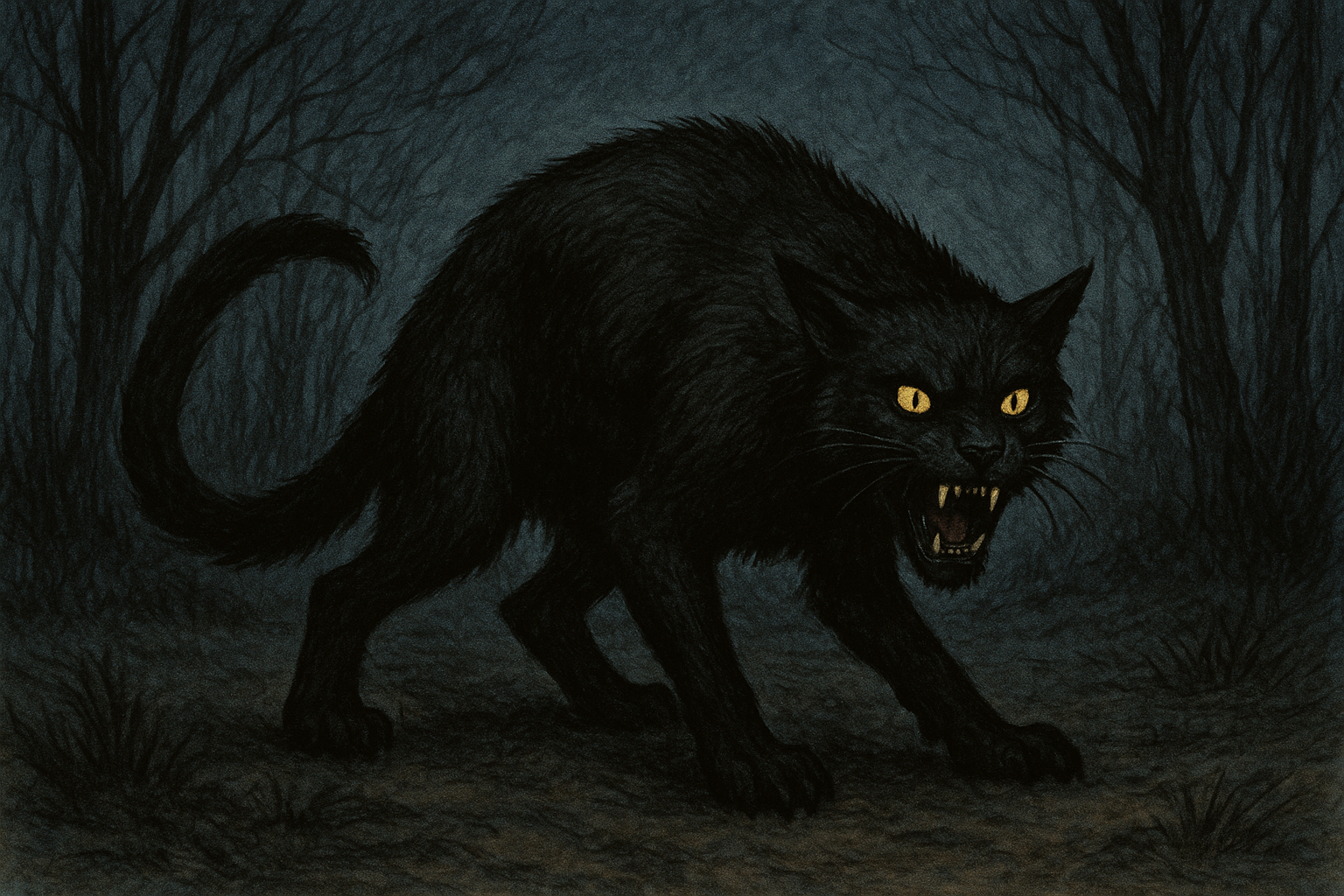
Description
The Legend of the Beast of Bladenboro — A Deep Dive
In the pine-flatlands of southeastern North Carolina, the small town of Bladenboro became ground zero for one of America’s most eerie and enduring cryptid legends. What started as a string of strange animal killings in the winter of 1953–54 exploded into national headlines — and decades later, the Beast still prowls the region’s collective memory.
Origins: How It Began
The first signs appeared in late December 1953, when residents began hearing terrifying noises — “like a woman screaming and a panther’s cry all at once.”
- On December 29, 1953, a woman reported hearing a strange sound outside her home, coming from a swamp-thicket near her yard.
- Just two days later, on December 31, two dogs belonging to a local resident were discovered dead — their skulls crushed, ears chewed, and their bodies strangely drained of blood. The local police chief admitted he had never seen anything like it.
- Over the next couple of days, more dogs were found dead under similar bizarre circumstances — leading locals to lock pets indoors at night and lock barn doors after dark.
The killings were horrific enough on their own. But the more haunting element was the noises: deep growls, unearthly screams — sometimes compared to both a panther’s roar and a human scream.
Then, on January 3, 1954, a woman claimed to have seen the creature behind her house — a feline shape with a long tail, weighing perhaps 90–100 lbs. Shortly after, a resident found another half-grown dog killed and dragged into the woods.
By January 4, the story had reached local newspapers; by January 5–6, the media attention had drawn hunters and curiosity-seekers from across the region. Headlines calling the creature “the Beast” spread far beyond Bladenboro.
The Panic: Hunting Parties and Hysteria
As the fear escalated, the town’s calm portrait turned chaotic.
- Hundreds of armed hunters, trappers, and thrill-seekers descended on Bladenboro, tramping through swamps and woods, hoping to track or kill the creature.
- People kept shotguns loaded by their doors. Parents forbade children from walking outside alone. Barn doors stayed shut after dusk. The town turned fearful, defensive, uncertain.
- Some hunters claimed to glimpse a crouching shape in a clearing — a beast that hissed or growled before darting off at unnatural speed. Others reported tracks that vanished in the sandy soil. Yet despite all this, no conclusive evidence, no corpse, no photograph ever emerged.
Then — almost as suddenly as the terror began — the attacks stopped. The last major sighting was around January 13, 1954. After that, animal mutilations, bloodless corpses, screams in the night: none returned.
Sightings, Reports, and Theories Over the Years
Though the original wave ended within a few weeks, the Beast never entirely vanished. Over the decades, sporadic reports kept the legend alive.
- Some locals have claimed to see a large, black, cat-like animal crossing rural roads near Bladenboro — especially in the 1970s, 1980s, and early 2000s.
- In the 2010s and 2020s, renewed livestock killings — goats and other farm animals found dead with throat wounds and sometimes blood drained — sparked speculation that the Beast (or something like it) might have returned.
- Shadows, eerie nighttime noises, glimpses — the stories come in piecemeal, with no concrete proof, yet enough little mysteries to keep curiosity alive.
What Could It Be?
Over the years, a few explanations have been proposed — ranging from plausible to paranormal:
- A large wild cat (cougar, bobcat, or panther) — though by the 1950s, cougars and panthers were considered functionally extinct in that region.
- A coyote or misidentified wild predator — though the brutality and the blood-drained corpses don’t match typical predator kills recorded in the region.
- A hoax, mass hysteria, or rumor-driven panic — perhaps exaggeration by newspapers, or a string of unrelated animal deaths framed into a terrifying narrative.
- A cryptid — a truly unknown or “otherworldly” creature, something beyond standard biology. The legend evolved over decades: glowing eyes, unnatural speed, near-supernatural strength.
Yet despite decades passing, no definitive proof has emerged: no carcass, no bones, no photos, no DNA. That’s part of what makes the Beast’s story so compelling — and so eternal.
The Legend Persists: From Horror to Heritage
What began as fear and horror has gradually transformed into folklore, heritage — and even community branding for Bladenboro.
- In the 2000s, a local nonprofit embraced the legend and helped found Beast Fest. The festival, held annually at the end of October, brings together music, vendors, costumes, and local lore — attracting visitors and celebrating the town’s uniqueness.
- Local businesses nod to the Beast in merchandise — hoodies, decals, art — turning fearsome folklore into playful branding.
- In classrooms, the legend is used as a learning tool — comparing newspaper reports, analyzing eyewitness descriptions, and teaching students about folklore, media literacy, and historical claims.
The Beast has shifted from a terror of the unknown to a unifying legend — something that ties past and present together, giving Bladenboro a story and a sense of identity it might otherwise lack.
Why the Beast Still Captivates Us
Why does the tale of a few nights in 1953–54 still echo so loud, decades later? Because it taps into something primal and universal:
- Fear of the unknown. Even in modern America, the idea that something wild — something unaccountable — might be lurking in the darkness remains deeply unsettling.
- Mystery + ambiguity. There’s no “solution” to the Beast. With no body, no evidence, no definitive explanation, the story can shift and evolve.
- Community identity. Bladenboro may be a small, quiet town — but the Beast gives it a story, a legacy.
- Folklore as comfort and curiosity. While legends about vampires, werewolves, and cryptids often carry horror, they also carry a strange comfort: a sense of community, of shared myth, of something beyond the mundane.
What We May Never Know
Even now, more than seven decades later, the Beast remains unsolved.
- No confirmed physical evidence.
- Conflicting eyewitness reports — size, shape, behavior, location, even the victims.
- Explanations ranging from plausible (wild cat, coyote) to speculative (cryptid, supernatural) — none conclusive.
- A legend that has mutated over time: fear turned to folklore, horror turned to heritage.
Perhaps what the Beast of Bladenboro ultimately represents is a human truth: sometimes what matters about such stories is not whether they’re real — but what they say about us. About community, memory, and the need for mystery.
Behavior
Killed animals, drained blood, vampire-like attacks
Reported Sightings (0)
No reported sightings yet.
Geographic Distribution
North Carolina, USA
Bladenboro area
Characteristics
Cat-like, possibly cougar-sized
Historical Context
January 1954
1954 Bladenboro incident, extensively documented