Somerset Place, Creswell, North Carolina
Somerset Place: The Haunted History of a North Carolina Plantation
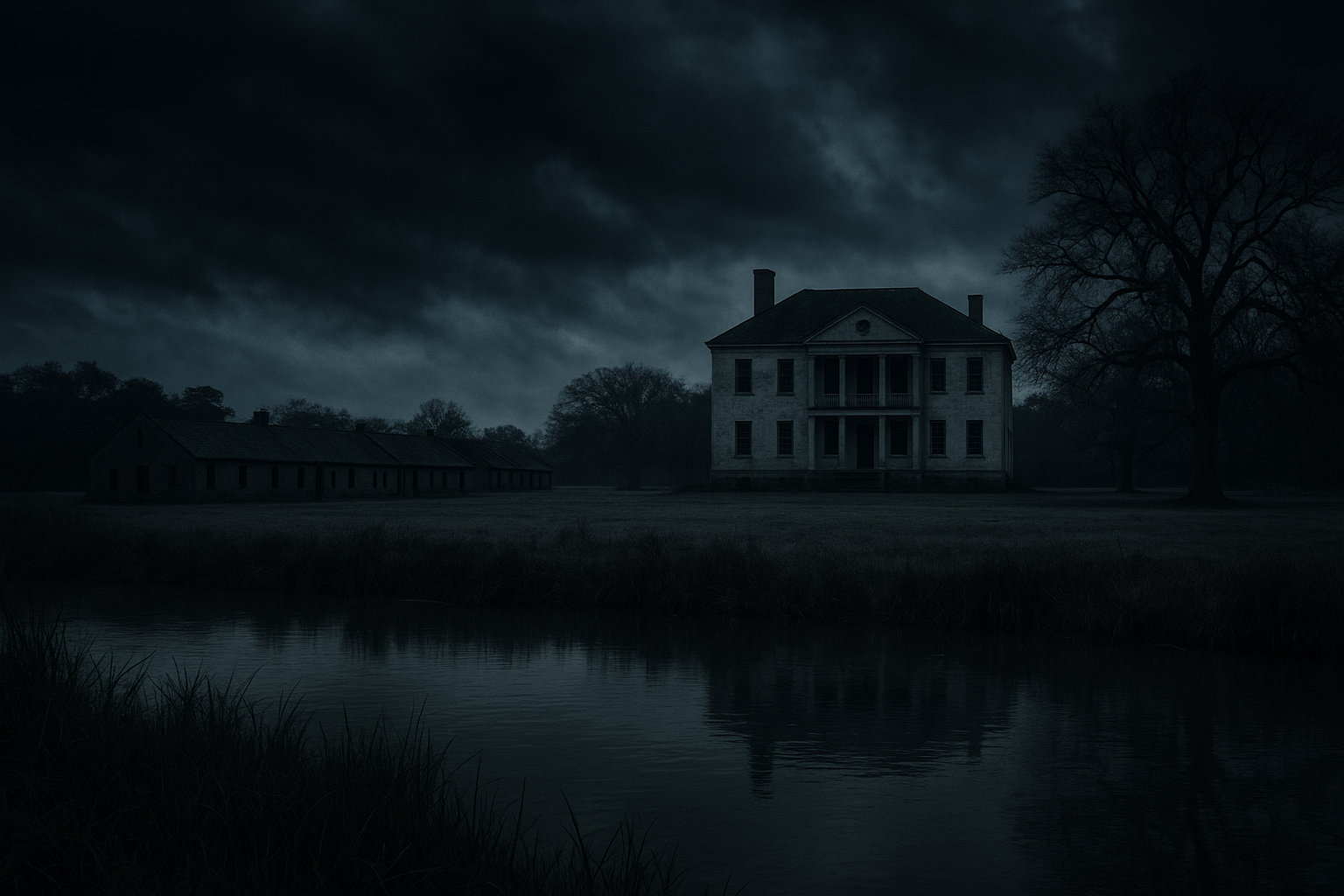
There’s a kind of silence that lives in marshland — a low, wet hush broken only by the rasp of insects and the slow sigh of wind across water. Drive into the long approach to Somerset Place, near Creswell on the northern shore of Lake Phelps, and that hush arrives fast. The white Collins mansion, the rows of reconstructed slave dwellings, the long canals cutting through low fields — the place feels like a living photograph, a 19th-century tableau preserved in the flat light of eastern North Carolina. But the preservation is not only architectural. Here, memory — and for some, something stranger — seems to linger in the soil, the ditches, and the buildings themselves.
A plantation built from swamp and suffering
Somerset Place began in the late 18th century as an ambitious land experiment. What had once been swamp was drained through an intricate system of canals, transforming wetlands into productive farmland. Over time, the plantation grew into one of the largest in North Carolina, producing rice, corn, wheat, and livestock.
This transformation came at an enormous human cost. Hundreds of enslaved men, women, and children lived and labored at Somerset over its eighty-year history. Their work carved the canals, maintained the fields, built the structures, and sustained the Collins family’s wealth. Enslaved families formed communities here, raised children, practiced skilled trades, and endured violence, disease, separation, and death.
By the time the Civil War ended in 1865, Somerset Place as a plantation economy collapsed. What remained was a vast landscape shaped almost entirely by forced labor — and by lives rarely acknowledged in traditional plantation histories.
Why people say Somerset Place is haunted
Visitors often describe Somerset Place as “heavy.” The air feels thick. Sounds seem to carry oddly across the water. Even on bright days, the site can feel subdued, as though the land itself remembers.
Stories of hauntings have circulated for decades. Some visitors claim to hear footsteps where no one is walking, or voices near the slave dwellings and plantation hospital. Others describe sudden cold spots, overwhelming sadness, or the sensation of being watched. A few speak of seeing figures — fleeting shapes that vanish when approached.
These stories are especially common around the canals, which were essential to the plantation’s success and among its most dangerous features. Folklore tells of a child who drowned in one of these waterways and whose spirit still lingers near the water’s edge. Whether literal or symbolic, the story reflects a deeper truth: daily life at Somerset involved constant danger, especially for children growing up in an environment shaped by labor and control.
The slave quarters and the weight of memory
The reconstructed slave dwellings are often described as the most emotionally intense part of the site. Visitors sometimes report hearing whispers or movement, even when alone. Others feel sudden waves of grief or unease that they can’t explain.
These reactions are not surprising. These structures represent family life under bondage — places where people loved, argued, celebrated, mourned, and survived under constant threat. The walls symbolize resilience, but also confinement. Many who walk through them experience a powerful emotional response, one that can easily be described as “haunting.”
In this sense, Somerset Place is haunted not by ghosts in the traditional sense, but by unresolved history — by stories that were silenced for generations and are only now being fully told.
The mansion: beauty and echoes
The Collins mansion stands in stark contrast to the slave dwellings. Its symmetry, furnishings, and scale reflect privilege and control. Yet even here, stories of hauntings persist. Some visitors describe hearing doors open or close, footsteps on stairs, or voices echoing through empty rooms.
The mansion was never an isolated space. Enslaved people worked here constantly — cooking, cleaning, caring for children, maintaining fires, and preserving the household’s daily rhythm. Their presence was continuous, even if officially unacknowledged. Walking through the mansion today, it’s easy to sense overlapping lives — those who claimed ownership and those whose labor sustained everything.
Descendants, homecoming, and reclaiming the past
One of the most meaningful chapters in Somerset Place’s modern history came when descendants of the enslaved community returned for a large homecoming reunion in the 1980s. Families gathered on the land their ancestors had worked, many for the first time knowing exactly where their roots lay.
For descendants, Somerset is not a haunted curiosity. It is sacred ground — a place of loss, endurance, and connection. What some visitors call ghosts, others understand as ancestral presence and memory. The land holds names, stories, and relationships that were once erased.
This perspective challenges how we talk about hauntings. Sensational ghost stories can easily overshadow the real human history of bondage and survival. Responsible storytelling places the people — not the paranormal — at the center.
Visiting Somerset Place today
Today, Somerset Place is preserved as a historic site, offering guided tours, exhibits, and walking trails along Lake Phelps. Visitors encounter a layered experience: natural beauty alongside stark reminders of slavery; carefully restored buildings alongside reconstructed spaces meant to honor everyday life for the enslaved community.
Those who visit with openness often leave changed. Some feel unsettled. Others feel reflective, grounded, or deeply moved. Few leave untouched by the experience.
What “haunted” really means at Somerset
If Somerset Place is haunted, it is haunted by truth.
It is haunted by the labor etched into canals and fields. Haunted by families broken apart and rebuilt in defiance of bondage. Haunted by stories once ignored and now slowly reclaimed. The quiet that settles over the site is not emptiness — it is presence.
To walk Somerset Place is to feel the past pressing gently but firmly against the present, asking not for fear, but for remembrance.
Location Photos (0)
No photos yet. Be the first to share a photo of this location!